
According to the FBI, did you know that insurance fraud costs insurance companies (and ultimately consumers) more than $50 billion each year? This equates to approximately $500 in increased annual premiums for each one of us.
Plus, when you start adding lost productivity for businesses, ruined family finances, and the cost to investigate and prosecute, the total figure is probably much higher.
For the most part, these fraudsters aren’t criminal masterminds. Here are five of the craziest insurance fraud scams we have ever encountered, from phony slip-and-falls to fake deaths to desperate business owners.


1. Four women made up a man, faked his death, and staged a funeral – tombstone and all. Four California women were convicted of wire fraud after they allegedly invented a man (“Jim Davis”), faked his death, and then staged a funeral. The criminals went so far as to purchase a burial plot for and bury him without a headstone. But despite the extravagant funeral described on paper for the financial assignment companies—including an ornate casket and elaborate floral arrangements—the funeral was a simple affair, attended by several phony family members recruited to play the part of mourners in case anyone was watching.
 
After two insurance companies launched an investigation into their claims on Mr. Davis’ $1.2 million in life insurance, the FBI arrested Jean Crump, Faye Shilling, Barbara Ann Lynn, and Lydia Eileen Pearce in 2010.
 
2. Security cameras catch two jewelry wholesalers staging a robbery at their own store. In December 2008, two New York City business partners hatched the ultimate plan to save their struggling jewelry business – a fake heist. Prosecutors claimed Atul Shah and Mahayeer Kankariva hired two men, dressed them in Hasidic Jew costumes, and staged a robbery at their shop. To cover their tracks, they poured chemicals into their security cameras to destroy any footage. They then filed a $7 million claim with their insurer, Lloyds of London.
Unfortunately for them, police were able to salvage the footage from the damaged security tapes. They showed the men entering their own safe and removing all the jewelry two hours before the supposed burglary.
 
In March 2011, both men were convicted of insurance fraud, attempted grand larceny, and falsifying business records.
 
3. A security camera captured a man allegedly faking an injury on a wrecked bus. When Ronald Moore saw what he thought was a serious bus accident, he hatched the ultimate get-rich-quick scheme: Pretending to be a passenger, he dashed onto the bus, clutched his back in pain, and later filed a claim for injuries, prosecutors claimed.
Unfortunately for him, the whole charade was caught on tape. According to Assistant District Attorney Linda Montag, the accident was a tiny tap by a taxicab. There wasn’t even a scratch on the bus.
 
Moore was ordered to pay a $1,000 fine and sentenced to 2 years of probation.
 
4. Woman files 49 slip-and-fall claims in seven years. When Isabel Parker rant out of funds to support her gambling addiction, the 72-year-old orchestrated 49 slip-and-fall scams at department stores, supermarkets, and liquor stores in three different states.
An investigation by detectives from the Philadelphia District Attorney’s Insurance Fraud Unit revealed Parker used as many as 47 aliases and 11 different addresses to file her claims, which totaled more than $500,000.
 
She was convicted of 20 counts of insurance fraud in 2003 and served a four-year sentence under house arrest.
 
5. Man allegedly uses Wikipedia photos to claim a $20,000 insurance policy on his nonexistent pet cat. Washington insurance officials claim Yevgeniv Samsonov tried to bilk his insurer out of $20,000 to cover his nonexistent cat’s death. In 2009 he claimed his pet died in an auto accident.
 
Dissatisfied with the offered settlement from the cat’s insurance company, Samsonov supposedly sent photos to prove the cat’s value. However, the adjuster’s quick web search for the insurance company proved the pictures were actually taken from a Wikipedia page.
Many people are hesitant to file claims with their auto insurance company out of fear that their premiums will be increased or the policy will be cancelled.  While practices vary between insurance companies, more will increase your premiums by a predetermined percentage for each chargeable claim made against your policy above a specific dollar amount.

A chargeable claim is one that an insurance company considers to primarily be your fault.  Also, these premium increases will generally stay on your premium for three years following the claim.

Your insurance company also has the right to not renew your policy if your driving record get worse or you have had several accidents.  Insurance companies differ in what they feel constitutes a bad driving record; however, most of them view two minor violations (minor speeding, moving violations, etc.)  or one major violation (excessive speed, DUI, etc.) within three years as a poor driving history.

You may also decide not to renew your policy if your driving record gets markedly worse or you have several accidents. Different insurers have different rules about what constitutes an unacceptably bad driving record. But some accidents, such as those caused by drunk driving, will probably trigger a nonrenewal from virtually every insurance company.

If you have an accident but don‘t report it to your insurer, you are taking a risk, even if the damage seems minor. If the other driver sues you weeks or months later, your failure to report the accident might cause your insurer to refuse to honor the policy. And even if they do honor the policy, the delay will certainly make it harder for the insurer to gather evidence to represent you.

THE TOPIC

With the recent earthquake in California, we through we would share some insight into earthquakes and insurance.  Earthquake, at least for insurance purposes, is defined as a sudden and rapid shaking of the earth caused by the shifting of rock below the earth’s surface.

Earthquakes are not covered by a standard homeowners insurance policy.  Coverage must usually be purchased via an endorsement or on a separate policy.  Also, according to the U.S. Geological Survey the U.S. experiences approximately 20,000 earthquakes a year.

As development increases in seismically active areas so does the risk for loss when an earthquake hits.   In July 2014 the U.S. Geological Survey updated its U.S. National Seismic Hazard Maps. The new maps reflect the best and most current understanding of where future earthquakes will occur, how often they will occur, and how hard the ground will likely shake as a result.

The new maps show that 42 states are at risk, with 16 states that have experienced earthquakes with a magnitude 6 or greater and which are considered at high risk.

Earthquake hazard is especially high on the West Coast, the intermountain west and in several active regions of the central and eastern U.S.

EARTHQUAKE INSURANCE COVERAGE

As there are no national earthquake programs, coverage is usually purchased through a private insurance company.  (However, some states, like California, have put together state programs.)

  1. Private Insurance Company:  Just like with flood insurance, there are several insurance companies that have put together programs for earthquake insurance you can purchase separately or in conjunction with flood and landslide coverage.
  2. Your Current Homeowner’s Policy.  There are some states where you are actually able to purchase earthquake coverage through your homeowners insurance policy.

Items to Note:

    • Your deductible is almost always a percentage of the coverage limit (typically 5%).
    • Pay special attention to your policy if you purchase earthquake coverage through your homeowners insurance company.   While you will have coverage for earthquakes, your policy will most likely exclude everything else related to land movement, including landslides/mudslides.

If you would like to find out more about earthquake insurance, please contact our office.

What does my credit rating have to do with purchasing insurance?

Everyone knows that credit scores are an evaluation of your payment history on a variety of consumer debt items like your home, credit cards, auto loans, etc.  Credit scores are also used for a variety of other purposes such finding a place to live, getting a cell phone, and, most recently, buying insurance.
Insurance companies have found a direct correlation between one’s credit score and likelihood of filing an insurance claim at some point in the future.  According to the actuarial tables and statistics the lower your credit score, the more likely you are to file a claim. So insurance companies are knowing using credit scores to generate an “insurance score” as part of the underwriting process.  Your insurance score plays a large role in determining the premiums charged by your homeowners and auto insurance companies.
Therefore a solid credit history can go a long way to decreasing your insurance premiums.  We recommend checking your credit score regularly and requesting that any discovered errors are immediately corrected.
The Fair Credit Reporting Act (FCRA) requires each of the nationwide consumer reporting companies—Equifax, Experian, and TransUnion—to provide you with a free copy of your credit report, at your request, once every 12 months. For more information, go to the Federal Trade Commission’s Web site on credit.

Distracted driving is quickly becoming one of the most dangerous hazards on the road, especially among teenage drivers.   With auto insurance rates already high for these young drivers, it’s important that you try and avoid any potential insurance claims.

Chubb Insurance just released an article that highlights some of the available technologies to help your teen drivers avoid distracted driving and stay safe on the road.  Some of the apps actually put a lock on the texting function while driving, while others monitor the driving behavior.

Here are some of the apps listed within the article:

DriveMode: This is a free app for Android and Blackberry users that actually responds to all incoming texts with a short message that the recipient is driving and will respond to them soon.

Canary: Canary is an app for both the iPhone and Android that allows parents to monitor their child’s cell phone usage in real time while driving.  It records the times the cell phone is used and actually notifies parents if the child attempts to disable it.

TextBuster: Is a hardware device you actually install in your car the temporarily disables text messaging, email, and internet access while the driver is in the vehicle.  It does, however, allow the phone to still make and receive phone calls and use the GPS.

iGuardian Teen: This is an Android app that actually shows parents what their child is doing in the car.  It monitors driving speeds, distance traveled, and phone usage.
If you are in the Denver Metro or Arvada area and you are interest in how using these apps will help you qualify for insurance discounts, please give our office a call.

Let The Holste Agency be your trusted Denver insurance partner.  As an independent insurance agent with access to over 50 different top insurance companies, we can provide you and your family with multiple money-saving insurance quotes for both your home and auto.   As a local Denver agency, we understand the local insurance climate; and, most importantly, where how to ensure you maximize your insurance discounts.
Additionally, our knowledgeable office staff will help answer any of your questions and provide guidance and assistance through any claims.  If you would like to find out more about how The Holste Agency can by your Denver insurance partner, please contact our office.

If you are looking for Arvada Life Insurance Quotes, then The Holste Agency can help you out.  Our expert staff can guide you through the Arvada Life Insurance options available to you and your family.   Additionally, we can help you calculate a proper limit, obtain multiple quotes, and purchase the policy that fits best.
Arvada Life Insurance will protect you and your family from unexpected tragedy by providing the financial assistance you need.
If you have any questions or you would like to receive a quote, please feel free to contact our office.

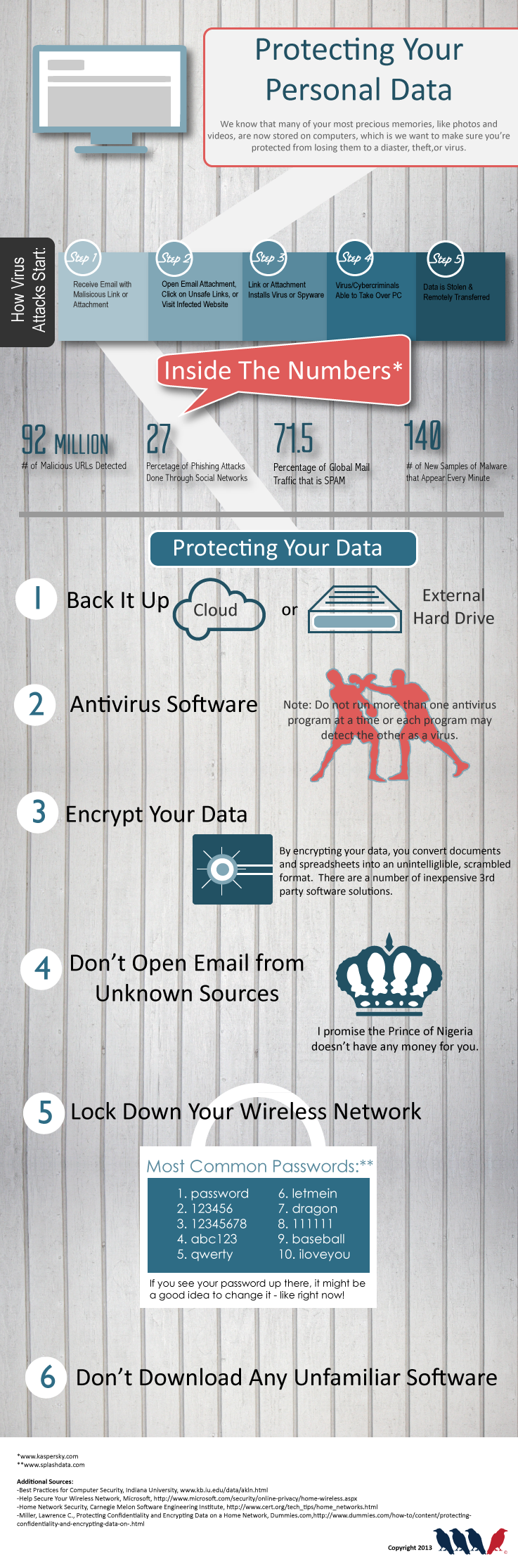
Have you ever thought about what you would do if you lost all of your family photos or videos due to a problem with your computer? Or what if your hard drive failed, causing you to lose all of your saved data?
As your insurance agent, our goal is to protect those items that are most valuable to you. And what is more valuable than the information many of us store on our home computers?
Knowing that families’ most precious memories like photos and videos are stored on computers now, we have put together an infographic with tips and tricks to protecting your personal data.
Within this guide you will find advice on how to ensure that some of your most precious assets are never lost or destroyed.